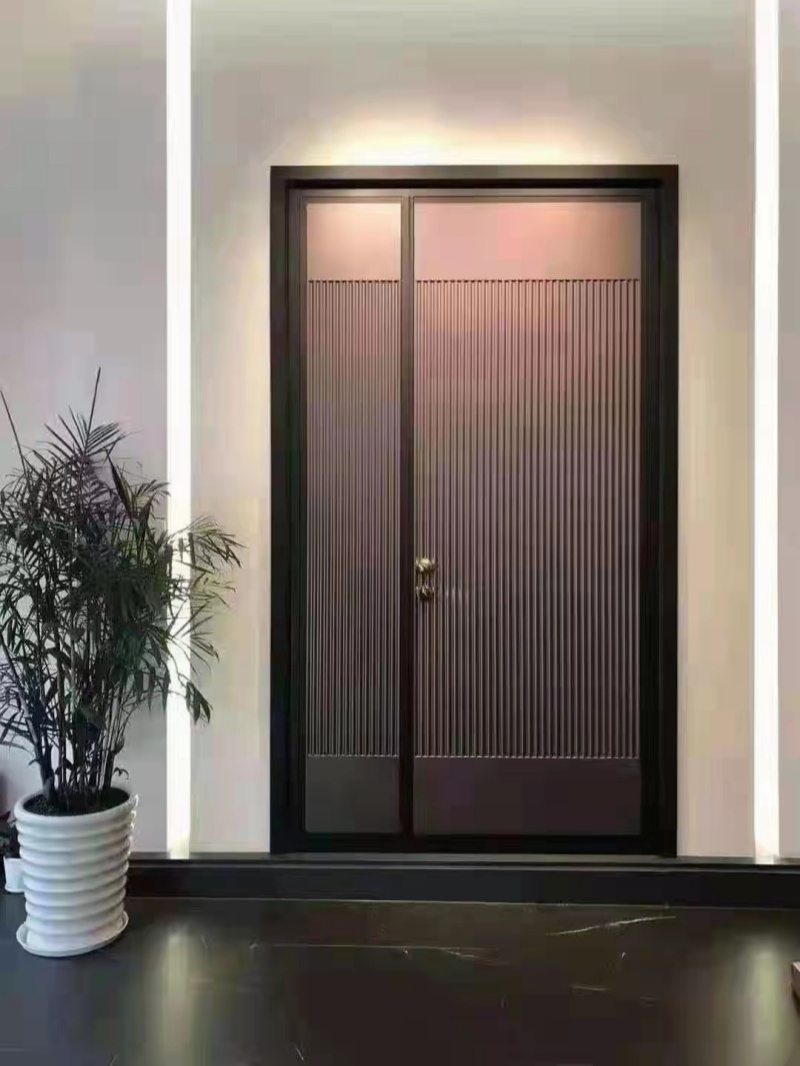
To achieve complete soundproofing against specific frequency bands in an aluminum door integrated with metamaterial structures, the design must combine tailored resonance control, multi-layered architecture, and precision engineering. Below is a systematic approach:
1. Frequency-Specific Metamaterial Design
Bandgap Engineering: Design unit-cell geometries (e.g., helical coils, labyrinthine channels, or split-ring resonators) to create phononic bandgaps that block targeted frequencies. For instance, nested Fano-resonant structures can suppress low-frequency waves (e.g., 100–500 Hz) by leveraging interference between discrete resonant modes and continuous scattering states.
Tunable Resonance: Incorporate adjustable components (e.g., piezoelectric actuators or magnetic shims) to dynamically shift the bandgap range, adapting to varying noise sources.
2. Composite Layered Architecture
Damping Core: Embed viscoelastic materials (e.g., silicone-rubber composites) between aluminum panels to dissipate vibrational energy. For example, a 3-layer aluminum-damping-aluminum sandwich reduces mid-frequency (500–2000 Hz) transmission by 20–30 dB.
Decoupled Mass-Spring Systems: Use air cavities or elastic spacers to isolate vibrations. A double-wall aluminum frame with a vacuum-sealed gap (5–10 mm) can attenuate high-frequency noise (>2000 Hz) through impedance mismatch.
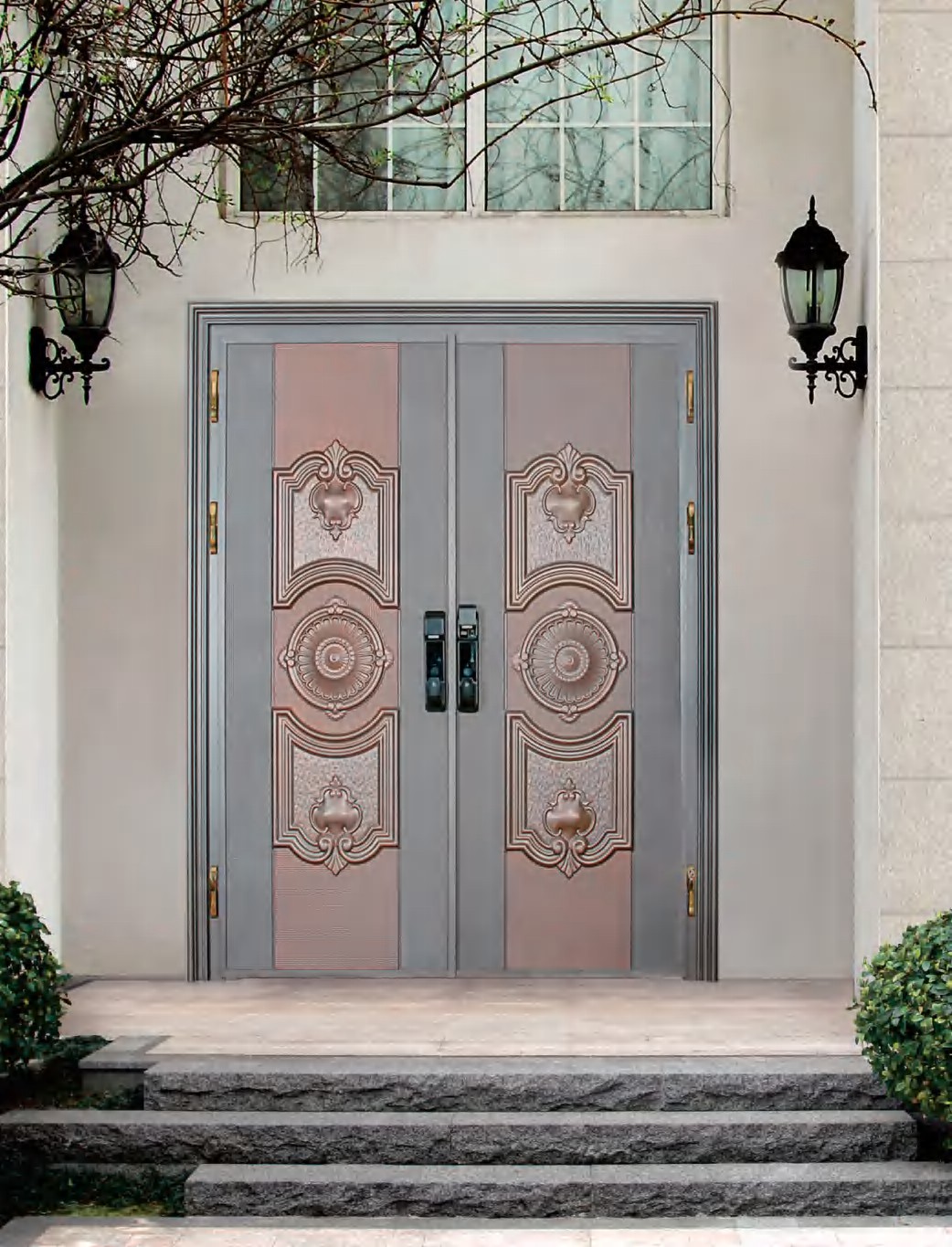
3. Hybrid Metamaterial Integration
Local Resonators: Attach subwavelength resonant units (e.g., membrane-type absorbers or coiled channels) to the door surface. These resonators convert sound energy into heat at specific frequencies, such as 315 Hz for HVAC hum or 1250 Hz for traffic noise.
Gradient-Index Structures: Deploy graded metamaterial arrays to broaden the effective bandgap. For instance, a spiral-shaped phononic crystal layer can extend attenuation across 200–800 Hz.
4. Advanced Sealing and Edge Treatment
Triple-Layer Seals: Use EPDM rubber gaskets with magnetic strips to eliminate flanking paths. Testing shows this reduces leakage by 15 dB at hinges and thresholds.
Acoustic Decoupling: Install anti-vibration mounts at door-frame junctions to prevent structure-borne transmission. A study demonstrated a 12 dB reduction in 63 Hz vibrations using polyurethane isolators.
5. Validation and Customization
Numerical Simulation: Optimize designs using finite element analysis (FEA) to predict transmission loss (TL) across frequencies. For example, a curved double-wall metamaterial achieved 50 dB TL at 2900 Hz in simulations.
Field Testing: Conduct real-world measurements with adjustable metamaterial prototypes. A 3D-printed Fano-resonant door panel showed 45 dB TL at 800 Hz in laboratory trials.
Application-Specific Optimization
Entrance Door: Prioritize broadband attenuation (100–3000 Hz) using hybrid metamaterials and heavy-duty seals to block urban noise.
Room Door: Focus on mid-high frequencies (500–4000 Hz) with lightweight membrane resonators for speech and music isolation.
Villa Door: Combine low-frequency dampers (e.g., Helmholtz resonators) and aesthetic finishes (e.g., wood veneer) for luxury environments.
By merging metamaterial innovation with traditional acoustic principles, aluminum doors can achieve frequency-selective soundproofing while maintaining structural integrity and design flexibility. Whether for an Entrance Door, Room Door, or Villa Door, this approach ensures tailored solutions for diverse noise challenges.